

Chelsea Cole
Director, Program Management

GRESB’s 2028 Real Estate Standard marks a major shift in how real estate portfolios are scored. Many management practices that previously earned points will become baseline requirements, while measured energy and emissions performance will account for 30% of the total score.
The 2028 assessment will evaluate 2027 performance. To put this into perspective: an efficiency or decarbonization measure in place by January 1 has a full year to deliver savings that show up in the data. A project that goes live in July has only six months.
With just over a month until the performance year begins, we break down how scores will change, what to prioritize, and how to prepare investors for what the new scores will mean.
The 2028 timeline
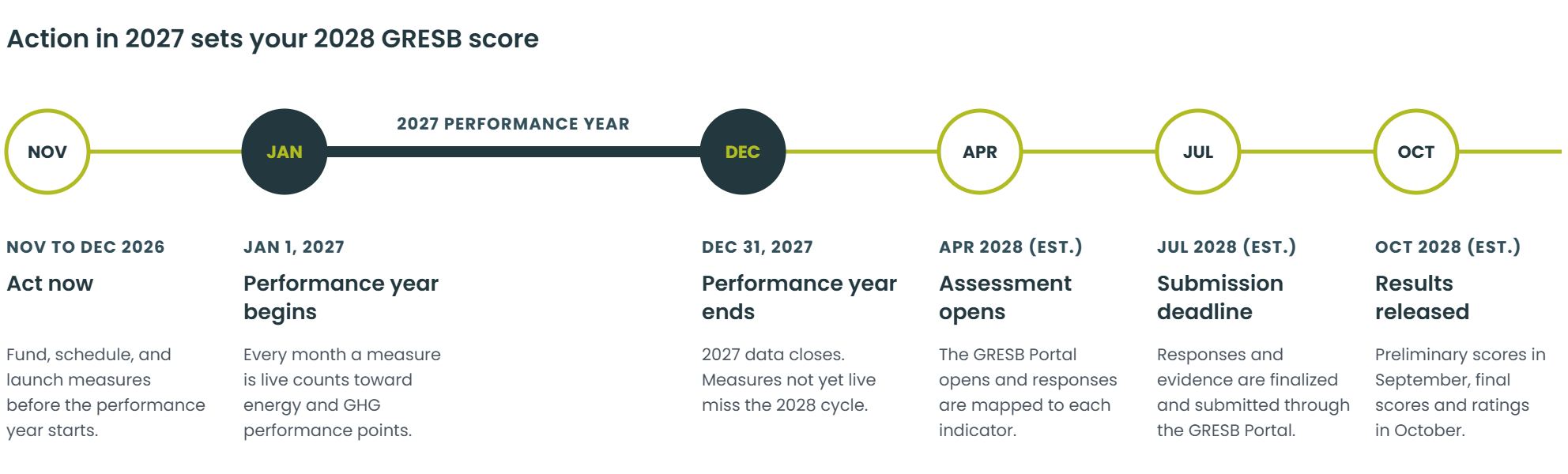
2027 performance year and 2028 GRESB assessment milestones
From policy to performance
The 2028 Standard shifts weight away from management strategies and toward measured outcomes. Much of the Management section becomes a baseline requirement (prerequisites) rather than a source of points. Decarbonization (Energy and GHG) performance alone now carries 30 points, or 30% of the score. In addition to the point shifts to prerequisites, some of the key changes to prepare for 2028 reporting are:
| Area | Before 2028 | 2028 Standard | What it means for owners and asset managers |
|---|---|---|---|
| Energy | 14 points across data coverage (8.5), energy performance (2.5), and renewables (3) | 17 points for energy performance, weighted by data quality and coverage | Prioritize projects that improve energy efficiency year over year and ensure whole-building data captures the savings. |
| GHG emissions | 7 points across data coverage (5) and emissions performance (2) | 13 points for emissions performance, weighted by data quality and coverage | Evaluate electrification and renewable electricity alongside efficiency upgrades to identify the largest emissions reductions at each asset. |
| Water | 4 points for data coverage | 5 points for data coverage | Close gaps in whole-building water data, including tenant usage where available. |
| Waste | 2 points for data coverage | 5 points for data coverage | Waste data coverage will carry the same weight as water data coverage. Start with properties where hauler or tenant records are incomplete. |
| Energy audits | 2 points | 4 points | Audits double in scoring value. Use the findings to prioritize efficiency projects for the next capital cycle. |
| Building certifications | Scoring emphasized the share of the portfolio certified | Fewer points overall, with greater weight on certification level | When choosing which assets to certify or recertify, consider the certification level each can achieve. |
| New indicators | Unscored or outside the assessment | Refrigerants (2 points), grid interactivity (2), biodiversity and nature (3.25), and innovation (3) | Review existing practices, such as refrigerant tracking and demand response participation, to identify what the portfolio can already document. |
Every month of delay costs points
GRESB 2028 scores what happened in 2027, not what was planned. Every month a measure waits on a budget cycle, an approval, or a more polished plan is a month of savings that never reaches the data. Not only does this limit the points scored against the all-important decarbonization indicators, but it also results in missed NOI uplift opportunities.
Consider a controls upgrade that cuts an asset’s energy use by 10%:
- Live January 1: the full 10% shows up in 2027 performance, and the property benefits from a full year of utility cost savings.
- Live July 1: roughly 5% shows up. Same capital, half the impact.
- Live in Q4: the reduction barely registers, and the full benefit waits for the 2029 cycle.
The earliest implementation delivers the biggest impact. It also compounds: lower operating costs start sooner, lower energy use reduces risk exposure from increasingly volatile utility rates, and the asset enters 2028 with a stronger baseline for the next cycle.
Plans don’t earn points. Implementation does.
A decarbonization roadmap has value in project prioritization, but under the 2028 Standard a roadmap on a shelf scores nothing. Points come from metered, verified reductions. The portfolios that gain in 2028 will be the ones that move from assessment to installed measures early in 2027.
Six moves to make before January 1
- Close data gaps. Install or upgrade metering, secure whole-building and tenant data, and confirm utility data feeds. Without coverage, performance points may not be captured or significantly discounted.
- Plan and prioritize. Review portfolio usage and emissions profiles to prioritize high impact strategies. Assets with high EUIs should target energy efficiency strategies; assets in clean electric grid markets will see biggest impact from electrification; and assets in dirty electric grids should balance efficiency and renewable electric supply strategies. Review asset performance and location variables to identify and prioritize the measures with the strongest financial returns and decarbonization impacts.
- Launch quick-win efficiency measures. Retro-commissioning, BAS and controls optimization, and lighting and controls upgrades can go live in weeks, drive savings for the full year, and typically have payback periods within a few years.
- Commission energy audits. Audits are now worth 4 points. They identify the next wave of measures to implement in 2027 and provide planning for the long-term efficiency and decarbonization roadmap to continue to see portfolio improvements and drive asset resiliency.
- Move electrification from plan to project. GHG points now reward decarbonization. Prioritize equipment near end of life for electric replacements, and line up incentives and financing now.
- Aim certifications higher. Points now favor certification level. Target the level, not just coverage.
A closer look at the new indicators
- Refrigerants (2 pts): refrigerant management, plans to address high-GWP equipment, and leak detection. Many portfolios are already positioned for partial points. An inventory now secures them.
- Grid interactivity (2 pts): demand response and peak load shaving, scored at the portfolio level. Office and large multifamily assets stand to gain. Smaller multifamily and industrial assets need a portfolio strategy to avoid losing ground.
- Biodiversity and nature (3.25 pts): previously unscored. European funds that already track these metrics for SFDR have a head start. US funds need a plan to capture these points.
- Innovation (3 pts): recognition for leadership practices the Standard does not yet capture, such as performance beyond targets, climate resilience, circularity, or embodied carbon. Each claim is validated by GRESB and disclosed to investors. Portfolios that implement, not just plan, will have the strongest claims.
Score recalibration
GRESB scoring is changing and will result in greater scoring variation between funds. Investors have expressed a desire to use GRESB to reward real world performance; the score updates will allow for meaningful performance differentiation.
Points will decrease and be redistributed to reflect a normal curve distribution. While in 2026, ~50% of funds scored about 85-95 points, projected scoring with the 2028 framework for the same funds show ~50% scoring around 60-75 points (notably, lower scores and greater point ranges). While in 2026 about 25% of funds scored 90 or above, less than 2% of funds are currently projected to rate that highly with the 2028 framework.
Overall, we expect that fund scores may drop ~10-30-point with the updated framework unless they move swiftly to implement decarbonization strategies in 2027 and prepare for the other changes. Here’s an illustrative example of what that could look like based on 2026 scores and for a fund that prioritizes implementation of decarbonization strategies within the next few months:
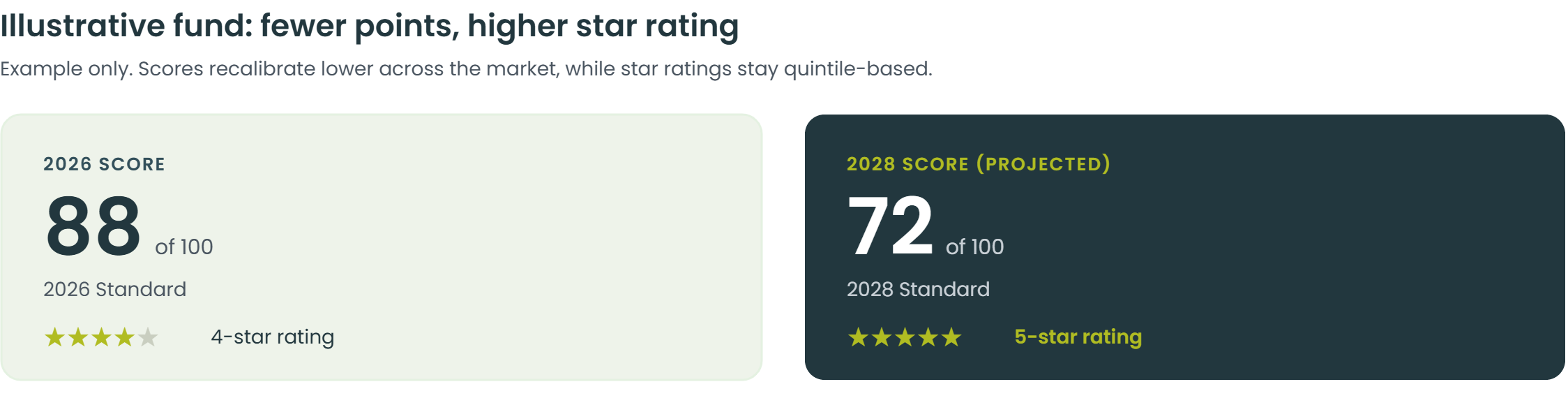
GRESB will continue to assign star ratings by quintile, so a lower score under the new standard may still earn the same star rating. What matters is how your portfolio performs relative to its peers. If your peers make significant gains while your performance holds steady, your rating could fall. If your portfolio improves while your peers hold steady, your rating could rise.
These changes will require that investors reframe how they evaluate fund performance and reset their expectations and target scores. GRESB has committed to communicating expected impact of score recalibration and redistribution on participant scoring to help investors contextualize the updated scores and ratings.
Preparing stakeholders for the 2028 score shift
Reset expectations early. Use 2026 and 2027 GRESB results to show stakeholders what the new scores are likely to look like. GRESB is releasing tools that estimate how 2026 funds would score under the 2028 framework, and the 2027 report will show scores under both the old and new frameworks. A fund that scored 70 in 2026 may score 50 in 2028. Giving stakeholders time to absorb the new numbers now avoids a shock when 2028 scores land for the first time.
Align on what drives the score. Review project and decarbonization strategies, plans, and their impact with stakeholders. Agree on the biggest score drivers under the new model.
Use 2028 as the bridge year. 2028 is the last year results will show scores under both frameworks. Use it to put fund performance in the familiar context, to start internal and external messaging on performance under the new framework, and to set a benchmark for future years.
Change how scores are read. Start conversations now about how to interpret scores. Under the 2028 updates, year-over-year improvement matters more than the point total. Star ratings will still be there for stakeholders and investors who track them. GRESB will also provide advanced ratings, such as regional and asset type ratings, which are more specific and meaningful to your fund’s performance and easier to act on.
Lead with the sections that matter to your organization. The 2028 Standard scores three components (decarbonization, portfolio management, and organizational management), not two (management and performance). Participants should focus their communication on the section scores or improvements that best signal alignment with their investment strategy and priorities.
A stable benchmark makes scores transparent and comparable
One significant improvement that we see with the updated scoring is the shift to a stable benchmark for performance evaluations. While up to now portfolio performance was normalized against an ever-shifting dataset of performance data from other GRESB participants, the 2028 update will use a fixed global benchmark that will remain consistent over three-year periods.
What does this mean? The current “black box” of performance scoring against unknown benchmarks is replaced with transparent benchmarks. Funds will now be able to accurately calculate projected impacts from projects or portfolio changes.
The consistent benchmark will also provide the ability to compare and track year-over-year performance. Over the last few years, GRESB participants have consistently expressed concern that scores from one year to the next do not reflect fund performance but instead are due to framework changes or shifting peer performance data benchmarks. Now, with a stable benchmark, performance points are only impacted by fund operations.
These changes highlight GRESB’s restructured emphasis on fund performance and decarbonization as the key strategies that drive asset value. Decarbonization has the most direct link to financial performance by impacting operating costs, transition risks, and long-term value protection.
The bottom line
In our experience, clients get the most value from GRESB when they use assessment findings to guide investment decisions. The 2028 Standard gives owners a stronger reason to prioritize projects that reduce energy use and emissions. Those projects can also lower operating costs, reduce exposure to transition risk, and protect long-term asset value.
Timing matters. A measure in place by January 1 can deliver a full year of savings in the 2027 performance data. A project completed later will still contribute, but only the savings realized during the remaining months will show up in that year’s results.
Ready to make 2027 count? Talk to our team about your implementation plan now.