

Imagine you invest in a large commercial property in Manhattan.
Two years into the hold period you discover that all rooftop units are at end of life and need immediate replacement. On top of that you learn that the building is not in compliance with upcoming Local Law 97 regulations and is subject to millions in fines over the next few years. None of this was flagged in due diligence, but now you’re facing an unbudgeted capital event. The efficiency upgrades that could have improved operating performance from day-one are now reactive fixes, squeezed into a budget and timeline that weren’t built for them.
The deal metrics shift. The capital plan gets rewritten. The value creation timeline compresses.
From Condition Report to Capital Strategy
Too often, energy efficiency, climate risk, and regulatory exposure are evaluated after a deal closes, once the business plan is already set and capital has been allocated. In a market defined by tighter margins and policy uncertainty, that sequencing leaves value on the table.
Leading investors are shifting this work upstream. By embedding these factors into pre-acquisition due diligence alongside the Property Condition Assessment and underwriting process, buyers can directly influence value creation, capital planning, and financing strategy before day one. When done well, this approach doesn’t slow transactions—it sharpens them, turning diligence into a roadmap in an otherwise uncertain market.
Today’s Market Reality
The investment landscape heading into this year is defined by structural change rather than cyclical noise. Real estate debt maturities are peaking over the next two years, interest rates remain volatile, and new sources of risk are emerging at the asset level. At the same time, market sentiment is improving. Investors are re-entering the market selectively, focused not on broad recovery plays, but on resilience and value.
The strongest opportunities are no longer tied to a single market or asset class. Instead, they sit at the intersection of resilient geographies, niche sectors (such as data centers), and assets capable of adapting to how buildings are actually being used. Performance-based building regulations are expanding across jurisdictions, operating costs are rising, and tenant demand is increasingly polarized between top-tier and lower-quality assets.
In this environment, pre-acquisition due diligence is no longer just about avoiding downside—it is a primary mechanism for identifying upside.
A Pre-Acquisition Process Designed for Action
Traditional due diligence answers the question: What condition is the building in today? A modern framework answers a more valuable question: What’s going to happen to this building in the future?
This framework looks forward, integrating regulatory changes and compliance risk, insurability, physical climate exposure, and even shifting occupant and market demands.
To stay ahead and maximize value, due diligence must evolve beyond observation into actionable insights that inform capital allocation and implementation roadmaps. A modern process should include:
- Data Review
Utility data, drawings, building reports, and the PCA are reviewed together to establish a technical and financial baseline. - Key Stakeholder Interviews
Discussions with onsite teams surface real-world operating challenges, maintenance patterns, and system performance that documents alone can’t reveal. - Onsite Assessment
A site walk validates assumptions, confirms equipment condition, and identifies operational inefficiencies. - Solution Development and Prioritization
Findings are translated into engineered, financially prioritized measures aligned with the investment strategy and hold period. - Investment-Ready Reporting
Deliverables are structured for underwriting and IC review, including costs, sequencing, regulatory considerations, and performance impacts.
Guided by GreenGen’s checklist which you can download in the link below, this process captures all critical information across regulatory, operational, energy, climate, and financial considerations. Insights from this structured approach are synthesized into actionable plans, ensuring that every observation, from equipment condition to operational practices, can be converted into capital decisions, efficiency improvements, and strategic roadmaps that maximize asset value.
The result is not a list of issues, but a plan that can be acted on immediately.
GreenGen’s Checklist for Actionable
Pre-Acquisition Due Diligence
USE CASE:
Where Traditional Diligence Leaves Value Behind
In one recent pre-acquisition review, the PCA alone painted a picture of stability. Systems were largely in “good” condition, with limited near-term capital needs. A deeper review told a different, and more valuable, story:
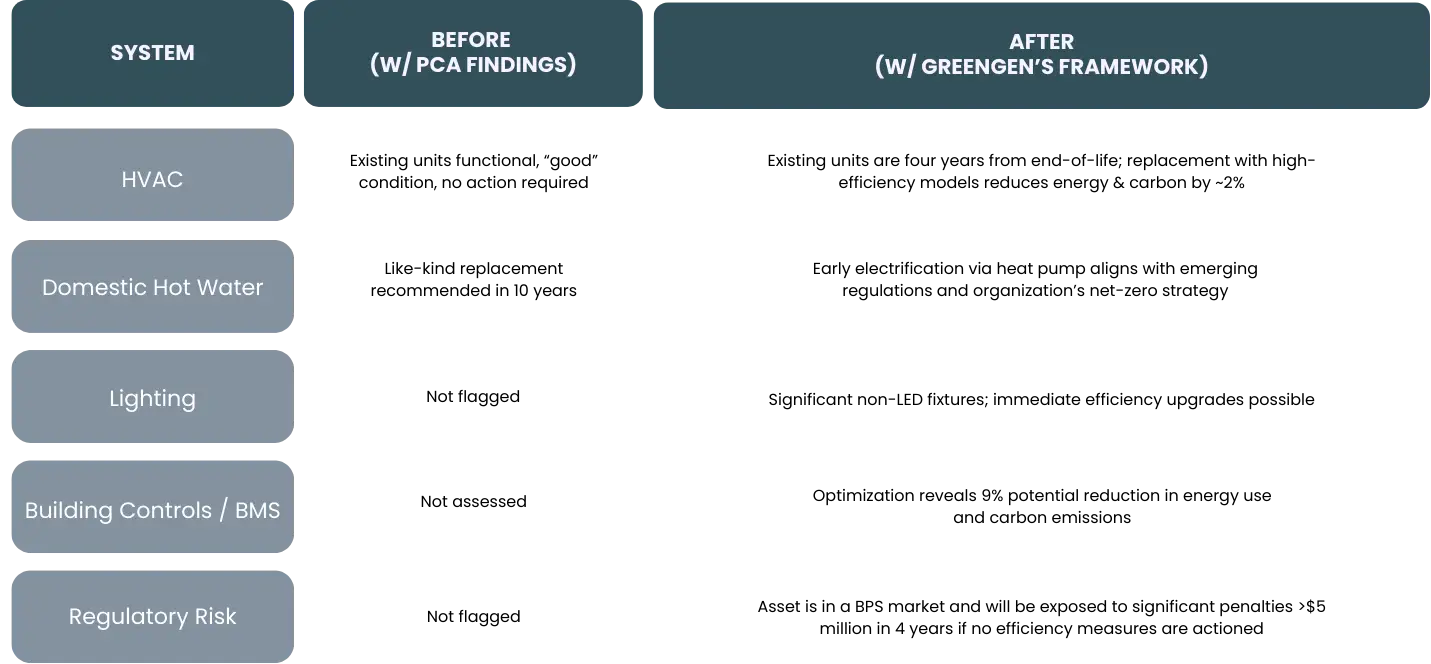
A traditional PCA identifies condition but misses forward-looking value opportunities. Actionable due diligence transforms condition data into a risk-adjusted strategy that informs capital planning, operational improvements, and long-term asset performance.
GreenGen applies this framework across client portfolios worldwide, uncovering hidden value, addressing operational and regulatory risks, and accelerating sustainable performance. The checklist captures critical insights across energy, climate, and capital considerations and translates them into actionable, investment-ready decisions.
For more information on GreenGen’s approach to pre-acquisition due diligence or to discuss how we can support your investment strategy, reach out to our team using the form below!