

Energy audits have long been part of effective property management. Today, they play a much larger role in capital planning as owners and investors navigate aging equipment, rising operating costs, and expanding building performance requirements.
But not every energy audit delivers the same value. Generic recommendations can make it difficult to determine which improvements are worth pursuing and when.
The most effective audits are tailored to the building, investment strategy, and business objectives. They can help owners identify opportunities to lower operating costs, plan capital improvements, manage regulatory risk, and improve asset performance.
This guide explains the different types of commercial energy audits, what they cost, and how to use audit findings to build a smarter capital plan.
What is a Commercial Energy Audit?
Energy audits are comprehensive assessments of a building’s energy and water use that evaluate the efficiency of equipment, building systems, and operations. They involve systematic analysis of utility consumption patterns, equipment performance, and building envelope characteristics to identify inefficiencies and optimization opportunities. As a best practice, these assessments should include water use, though not all scopes do. Energy audits provide actionable recommendations to improve energy and water performance, identify opportunities to decrease operating expenses, reduce emissions, and increase asset value. They serve as critical decision-making tools for property owners and managers by quantifying potential savings, prioritizing capital improvements, and establishing performance benchmarks against industry standards and regulatory requirements.
Why Energy Audits Are More Important Than Ever
Building Performance Standards (BPS) and regulatory requirements are expanding across jurisdictions, making energy audits increasingly essential. Property owners and managers who proactively conduct audits can mitigate risk, ensure compliance, and uncover cost-saving opportunities.
Beyond compliance, energy audits offer:
- Operational efficiency – Optimize equipment and systems to reduce energy consumption, lower maintenance costs, and improve tenant comfort. “
- Regulatory compliance – Stay ahead of evolving performance mandates and energy disclosure laws to avoid fines and penalties.
- Risk mitigation – Identify infrastructure vulnerabilities before they impact NOI or asset performance.
- Capital planning insights – Prioritize energy-efficient investments that align with long-term asset strategies.
- Asset value – Identify opportunities to reduce operating expenses, strengthen NOI, and improve long-term building performance.
How Are Energy Audits Conducted?
Energy audits typically follow a three-step process:
Step 1: Data Collection & Review
- Gather utility data (electricity, gas, water) for landlord and tenant systems.
- Review building documentation, including equipment specs and maintenance records.
- Conduct interviews with facility teams to assess current practices.
- Perform an on-site (or desktop) review of major building systems (HVAC, lighting, water, controls, and envelope).
Step 2: Analysis & Solution Development
- Model the energy profile to identify conservation opportunities.
- Align recommendations with the building’s operational needs.
- Develop a prioritized list of energy efficiency measures focused on cost savings and emissions reductions.
- Assess compliance with local regulations and potential financial incentives.
Step 3: Report & Action Plan
- Provide a detailed financial analysis, including capex, savings, and ROI projections.
- Identify available rebates, tax credits, and incentives to reduce implementation costs.
- Prioritize projects with clear cost-benefit analyses.
- Outline an actionable implementation plan, including budgeting and regulatory considerations.
ASHRAE Level 1 vs. Level 2 vs. Level 3 Energy Audits
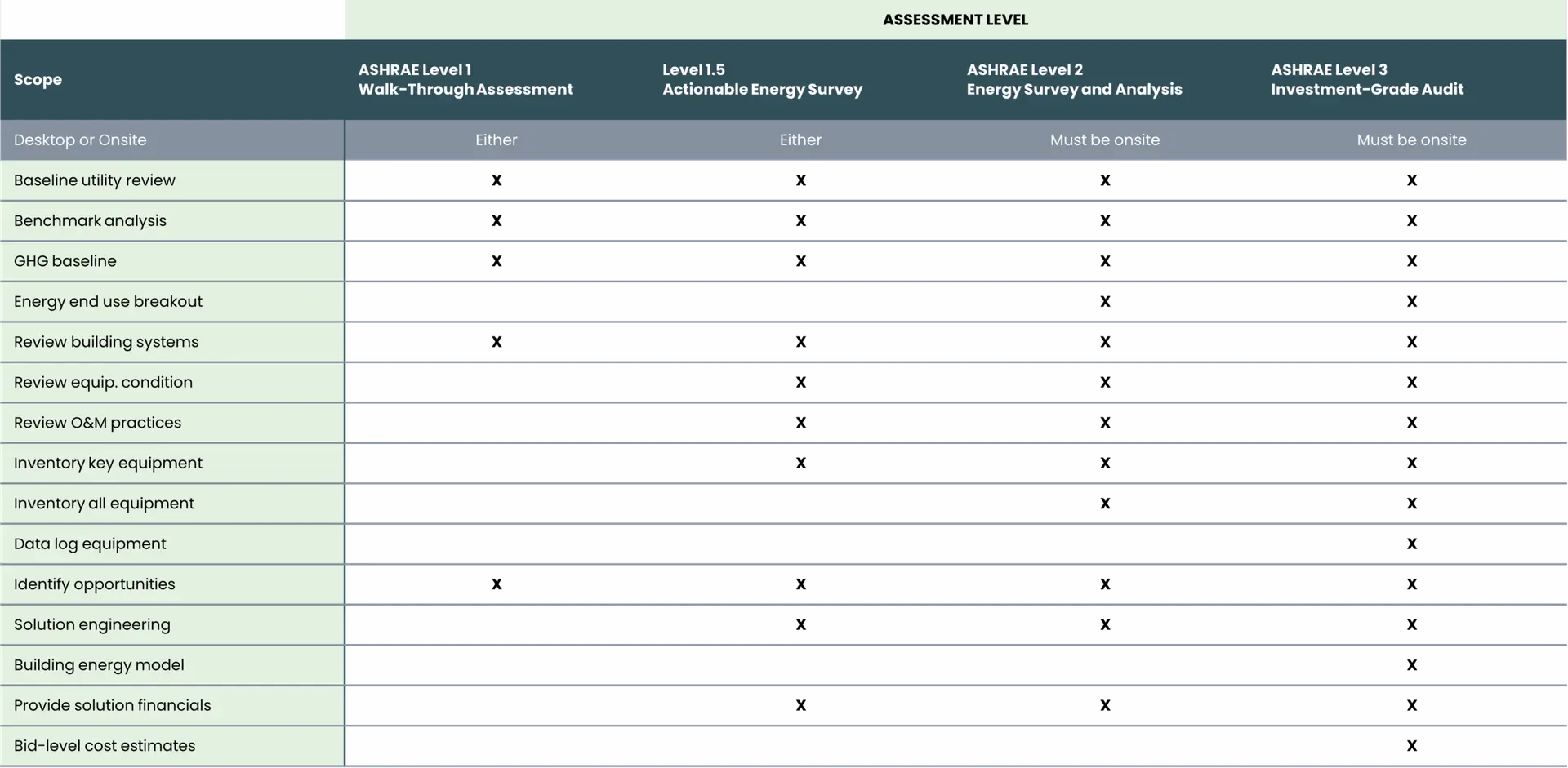
Energy audits can range from basic assessments to comprehensive technical analyses, each serving different strategic objectives. The American Society of Heating, Refrigerating and Air-Conditioning Engineers (ASHRAE) formally defines three standard levels of audits (L1, L2, and L3), creating a progressive framework of increasing depth and detail. However, at GreenGen, we’ve identified an additional intermediate level—Level 1.5—that often best addresses our clients’ specific needs by balancing thorough analysis with practical implementation. This “Actionable Energy Survey” bridges the gap between preliminary assessments and more resource-intensive evaluations, delivering targeted insights with streamlined efficiency. Choosing the right level depends on asset complexity, compliance requirements, and investment goals. Here’s a breakdown:
ASHRAE Level 1: Basic review identifying no-cost/low-cost efficiency improvements.
Level 1.5: This is GreenGen’s standard scope and targets high-impact systems, delivering prioritized solutions with financial analysis.
ASHRAE Level 2: A detailed site investigation providing technical and financial analysis of recommended measures.
ASHRAE Level 3: An investment-grade audit and analysis supporting large-scale capital investments with advanced modeling.
Additional Evaluations to Consider
Energy audits can be paired with additional assessments to provide a more comprehensive understanding of building performance. Common add-ons include:
- Regulatory Risk Review – Evaluate compliance with BPS and energy disclosure laws.
- Climate Risk & Resilience Review – Assess building vulnerabilities to climate-related risks.
- Net Zero Pathway Analysis – Develop a roadmap for achieving net zero emissions.
- Building Certification Gap Analysis – Compare current performance against certifications like LEED or BREEAM.
- Electrification Feasibility Study – Assess building readiness for electrification and grid decarbonization.
How Much Does a Commercial Energy Audit Cost?
Energy audit costs vary based on property size, complexity, and scope. As a general guideline, an ASHRAE Level 2 audit typically costs between $0.10 and $0.15 per square foot. Larger, simpler buildings tend to fall on the lower end of the pricing spectrum, while complex assets require more in-depth analysis and higher costs.
Timeframes also vary but generally follow this schedule:
- Desktop audits – Delivered within a few weeks.
- On-site assessments – Completed within 1-2 months.
Using Energy Audits for Commercial Real Estate Capital Planning
For commercial real estate owners and investors, the greatest value of an energy audit often comes after the assessment is complete. Audit findings provide the technical and financial inputs needed to prioritize capital based on expected savings, ROI, equipment lifecycle, regulatory requirements, available incentives, and broader asset strategy.
For example, an audit may identify an HVAC system that is inefficient but still operational. Immediate replacement may not offer the strongest return. But if that equipment is approaching the end of its useful life, ownership can evaluate a higher-efficiency replacement as part of an already-planned capital event—potentially improving the economics while avoiding unnecessary incremental spending.
This shifts the question from simply, “What can we improve?” to “Where should we invest, when should we invest, and which improvements can create the greatest value?”
Across a commercial real estate portfolio, the same approach can help owners prioritize which assets and projects warrant investment first. Audit findings can be evaluated alongside energy performance, equipment age, regulatory exposure, planned capital events, available incentives, hold periods, and investment strategy to build a more informed capital plan.
Rather than treating energy efficiency as a separate sustainability budget, this approach integrates building performance into the capital planning process, helping owners identify opportunities where financial, operational, and sustainability objectives align. As ROI in real estate continues to evolve, these decisions increasingly need to account for factors beyond energy savings alone, including financing, risk, resilience, and long-term asset value.
How to Maximize the Value of Your Energy Audit
Many property owners complete energy audits to meet compliance requirements, but the true value lies in leveraging audits as strategic planning tools. A well-executed energy audit helps real estate professionals optimize building performance, reduce risk, and unlock long-term asset value.
For a portfolio-wide approach, consider partnering with an energy solutions provider to develop customized strategies tailored to your specific asset mix and investment goals.
Just as importantly, the process should not stop when the audit report is delivered. Connecting findings to budgeting, engineering, financing, and implementation helps move identified opportunities from recommendations to realized results.
Frequently Asked Questions About Commercial Energy Audits:
What is a commercial energy audit?
A commercial energy audit evaluates a building’s energy and water use, equipment, systems, and operations to identify opportunities to improve performance, reduce operating costs, and prioritize capital improvements.
How much does a commercial energy audit cost?
Costs depend on building size, complexity, and audit scope. As a general guideline, an ASHRAE Level 2 energy audit typically costs approximately $0.10–$0.15 per square foot, although actual project costs can vary.
What is the difference between an ASHRAE Level 1 and Level 2 energy audit?
A Level 1 audit provides a preliminary assessment and identifies high-level efficiency opportunities. A Level 2 audit includes a more detailed site investigation and technical and financial analysis of recommended measures, making it better suited for project development and capital planning.
How can an energy audit support capital planning?
Energy audits help owners compare potential improvements based on capital cost, projected savings, ROI, equipment lifecycle, incentives, regulatory requirements, and asset strategy. This allows energy-related investments to be incorporated into broader capital planning rather than evaluated in isolation.
Turn Energy Audit Findings Into a Capital Plan
The value of an energy audit isn’t the report itself. It’s what you do with the findings.
A well-designed audit can help owners identify where to reduce operating costs, address regulatory risk, plan equipment upgrades, and prioritize capital across an asset or portfolio.
GreenGen works with real estate owners and investors to define the right audit scope and turn the findings into actionable capital plans based on asset needs, financial priorities, and regulatory requirements.
Planning capital improvements? Talk to our team about the right energy audit approach for your portfolio.